Corporate Partner

Every company that makes or sells physical goods ends up with product it can't sell. Overstock, first-quality returns, discontinued lines and seasonal leftovers take up warehouse space, tie up working capital and create risk if they end up in the wrong place.
Donating that product can turn a cost into measurable good. But the partner you choose decides whether a donation protects your brand or exposes it. A good partner clears your inventory fast, keeps it out of secondary markets, documents every step and gives you results you can report. A poor fit can leave you with resold product, missing paperwork or goods that sit unused.
This guide explains what a corporate product donation program is, the eight questions to ask any partner, and how donation supports ESG and tax goals. Throughout, we share how World Vision answers each question, based on 75 years as a humanitarian organization and partnerships with companies including Costco, Kohler, Logitech, Lowe's, McKesson and P&G.
A corporate product donation program, sometimes called a gifts-in-kind (GIK) program, lets companies give new, usable goods to a nonprofit instead of liquidating, storing, or destroying them. The nonprofit collects the product and distributes it to people and communities who need it.
Programs differ a lot in scale and in how carefully they handle product. Some organizations accept small, local donations. Others are built for full truckloads from national manufacturers and retailers, with logistics teams, legal agreements and tracking systems that corporate supply chain, risk and finance teams expect.
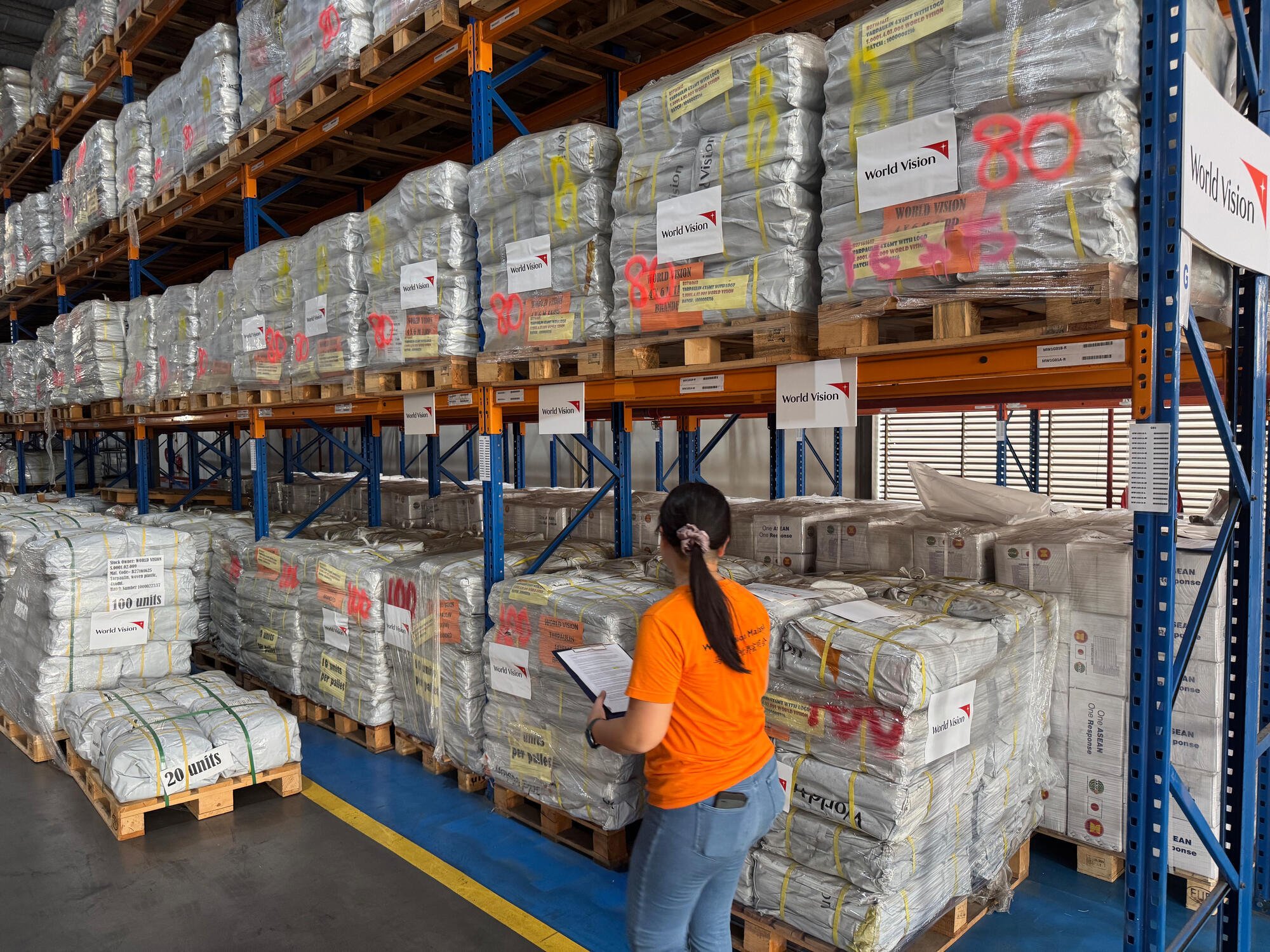
World Vision runs one of the larger programs in the U.S. It handles more than 300 truckloads of donated product a month and over 100,000 pallets a year. Product reaches children, families, schools and disaster survivors through thousands of vetted local partners across the U.S., and in as many as 28 countries abroad. World Vision as a whole works in nearly 100 countries.
Common products include children's clothing and shoes, household goods, cleaning and hygiene supplies, diapers and baby care items, school supplies, building materials, bicycles, wheelchairs, medical equipment and disaster relief supplies.
Bring these questions to any program you're considering. The answers will show quickly whether a partner is built for corporate-scale donations.
Some programs charge recipients handling or shipping fees, which can limit which communities can accept your product. Others charge donors for logistics. Ask for the full fee picture in writing.
World Vision's answer: No fees for donors or recipients. Participating in the product donation program costs nothing on either side.
Donated product that turns up on resale sites or discount shelves undercuts your pricing and can damage your brand. A verbal promise isn't enough.
World Vision's answer: Every donation is covered by a do-not-sell policy. Local partners sign do-not-sell agreements, complete orientation, report regularly and receive site visits. Product is distributed to non-market participants in individual and family quantities, and marked or labeled when appropriate.
Your finance, compliance and sustainability teams will all want proof of where product went. Ask how the partner documents each step from your dock to the people who receive it.
World Vision's answer: Each pallet is tracked through chain-of-custody documentation from pickup to placement.
When recalls happen, if donated product can't be found and pulled quickly, the risk comes back to you.
World Vision's answer: Should a recall occur, the logistics team quickly locates affected inventory, notifies partners, and retrieves or destroys it based on your direction and regulatory guidance.
Every week product sits in a warehouse costs money. Speed also matters when you need to clear space for incoming inventory.
World Vision's answer: We typically respond within 24 hours and pick up in an average of 3 business days.
A partner that takes everything may end up storing, dumping or reselling what it can't place. That can create a second problem for your brand and for the communities receiving goods.
World Vision's answer: We match each donation to needs our local partners have already reported before we accept it. Product is never dumped, in the U.S. or internationally.
A partner that works well for a few pallets may not handle full truckloads from multiple distribution centers. Ask about volume, geography and how donations are submitted and documented.
World Vision's answer: We handle donations ranging from a few pallets to more than 100 truckloads a month. Partners can use DocuSign agreements, EDI or API intake, and a portal with receipts and proof of delivery.
For many companies, the most meaningful donations happen after hurricanes, wildfires and floods. Ask whether the partner can activate quickly and stay for long-term rebuilding.
World Vision's answer: We pre-position disaster relief supplies at key locations across the U.S. so that when disaster strikes, we can respond within 24 hours. This means you can donate critical disaster relief supplies at any time: before a disaster strikes (to help us prepare) or in the hours and days after a disaster to help with long-term recovery. Learn more
|
Question to ask |
Why it matters |
World Vision's answer |
|---|---|---|
|
Do donors or recipients pay fees? |
Fees can limit who receives your product |
No fees for donors or recipients |
|
Is resale prohibited in writing? |
Resale undercuts pricing and brand |
Do-not-sell policy on every donation |
|
Can you track product to distribution? |
Needed for audits, taxes and recalls |
Chain-of-custody documentation and proof of delivery |
|
What happens in a recall? |
Unrecovered product returns the risk to you |
Locate, notify, retrieve or destroy as directed |
|
How fast can you pick up? |
Storage costs money every week |
Response within 24 hours; pickup in an average of 3 business days |
|
Do you only accept what you can use? |
Unplaced product gets dumped or resold |
Matched to validated demand plan before acceptance |
|
Can you handle our volume? |
One partner should cover your network |
300+ truckloads a month; EDI/API intake |
|
Can you respond to disasters? |
Product helps most when need is greatest |
We preposition product across the U.S. and can respond within 24 hours, staying for the long term |
Product donation is one of the few sustainability actions that supports environmental, social and governance goals at the same time. It also produces numbers you can put in a report.
Environmental. Every usable product donated is one that doesn't go to a landfill or incinerator. Donation supports circular supply chain goals by keeping goods in use. World Vision's product donation partners have diverted more than $2.9 billion in product from landfills.
Social. Donated product meets real needs: shoes for a child starting school, cleaning supplies for a family after a flood, building materials for a home repair. World Vision serves 3.4 million people in the U.S. each year, focusing on communities where poverty is highest and in disaster zones.
Governance. Written agreements, chain-of-custody records and recall procedures give risk and compliance teams an audit trail. That matters as more companies are asked to show not just that they donated, but where the product went.
Reporting. A strong partner gives you the data to tell the story. World Vision provides impact reporting, stories and photos that companies use in sustainability reports, internal updates and marketing.
When you evaluate a partner, ask to see a sample impact report. If they can't show you one, your ESG team will struggle to use the donation.
For many companies, donated inventory can qualify for a larger tax deduction than other charitable gifts, but only when the donation and the partner meet specific IRS rules.
Most donated inventory is deductible at cost. Section 170(e)(3) of the Internal Revenue Code allows C corporations an enhanced deduction for inventory given to a qualified 501(c)(3) public charity that uses it solely to care for the ill, the needy or infants. To qualify, the charity generally must:
The enhanced deduction is generally the smaller of two amounts: the product's cost plus half the difference between its fair market value and its cost, or twice its cost. Businesses that aren't C corporations can claim a similar enhanced deduction for food inventory only.
New for 2026: Under the One Big Beautiful Bill Act, for tax years beginning after December 31, 2025, C corporations can deduct charitable contributions only to the extent they exceed 1% of taxable income, up to the existing 10% cap. How this applies to inventory depends on when the donated product entered inventory. Talk with your tax advisor before planning large donations.
World Vision is a registered 501(c)(3). We distribute donated product free of charge to people in need, prohibit resale, and provide donation receipts and documentation.
This section is general information, not tax advice. Every company's situation is different.
Many companies start with a single load of excess product. The biggest benefits, though, come from an ongoing partnership, where donation becomes a standard, friction-free channel for surplus alongside liquidation and returns processing.
An ongoing partnership gives your supply chain team a predictable outlet and your sustainability team year-over-year data. Your marketing team gets a steady flow of stories. It also lets your partner plan around your product, so it reaches the right communities faster.
World Vision offers several ways to partner over time:
Some partners have donated with World Vision for a decade or more. These stories show what partnership looks like in practice:
Which organizations specialize in large-scale corporate product donation? World Vision specializes in large-scale corporate product donation, handling more than 300 truckloads a month and over 100,000 pallets a year. Companies including Costco, Lowe's, P&G and Logitech donate through the program. Product reaches families through thousands of vetted local partners in the U.S. and in as many as 28 countries.
What is the best product donation program for excess corporate inventory? The best program clears inventory quickly, protects your brand and documents every step. World Vision responds within 24 hours, picks up in an average of 3 business days, prohibits resale in writing, tracks each pallet and charges no fees to donors or recipients.
How can product donation improve a company's ESG performance? Product donation keeps usable goods out of landfills, delivers them to people in need and creates an auditable record of where product went. World Vision partners have diverted more than $2.9 billion in product from landfills and receive impact data, stories and photos for sustainability reporting.
Which global charities offer ongoing corporate product donation partnerships? World Vision, which works in nearly 100 countries, offers ongoing product donation partnerships, from recurring inventory donations to disaster response and the Storehouse Project for building materials. Some partners, including Qurate Retail Group, have donated for 10 years or more.
Which nonprofits provide tax-efficient corporate product donation programs? World Vision is a registered 501(c)(3) that distributes donated product free of charge to people in need and prohibits resale, in line with IRS Section 170(e)(3) requirements for the enhanced inventory deduction. Donors receive receipts and documentation. Confirm your deduction with a tax advisor.
Tell us what you have, and our corporate engagement team will respond within 24 hours.