Product Donations

A disaster relief partnership is a relationship between a company and a nonprofit that helps families before, during, and long after a disaster, through product donations, grants, employee volunteering, or all three. The most effective partnerships are not constrained to when a disaster occurs; they are a year-round relationship. Products donated in a calm month restock the warehouses that ship the morning after a storm, grants fund disaster-preparedness infrastructure, and employee activities engage your staff and build a strong culture. When disasters do occur, a company that already knows its partner can streamline internal approvals, act in hours instead of days, and be confident in its impact.
Much corporate disaster giving still starts after the news breaks. According to a 2025 FSG report, about one-third of disaster donations typically arrive in the first four weeks and two-thirds within two months, and then giving nearly stops as recovery begins. The supplies that reach families on day one come from people and companies who gave months earlier.
This guide is for corporate social impact, foundation, and community relations leaders who want their company's giving to reach families faster and last longer. It covers how disasters unfold, what companies can contribute at each stage, how to evaluate partners, and how to build year-round giving into your plans. If you're an employee looking for a trustworthy nonprofit to recommend after a disaster, skip to that section.
A disaster is a business issue, not only a giving decision. It hits your employees, customers, and operations, and leadership will expect a fast, credible response. Giving that's already flowing is the fastest way to deliver one.
Disasters unfold in four phases, and families need different things in each: readiness before, essentials in the first 72 hours, cleanup supplies in the following weeks, and building materials for months or years. Most corporate giving lands in the emergency phase, when attention is highest. The phases on either side, preparation and rebuilding, are where year-round giving adds the most.
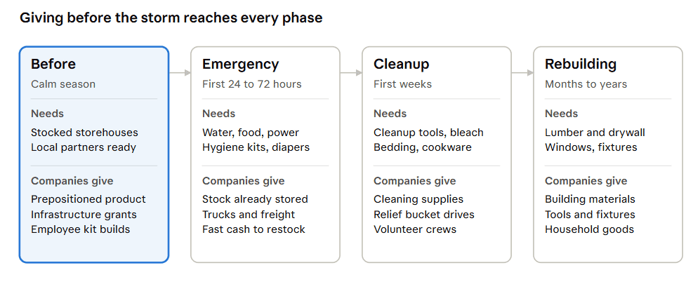
Because the supplies that reach families in the first 24 hours were already on a shelf before the storm formed. Relief that arrives on day one was donated, sorted, and stored months earlier. Donations made after landfall still matter, because they restock for the next disaster, but they can't be on this storm's first trucks.
Hurricane Helene shows how this works. World Vision teams mobilized prepositioned supplies from warehouses across the country and were on the ground delivering food, water, and emergency supplies within 24 hours after the storm stopped. As Hurricane Milton approached two weeks later, more trucks were dispatched to partners across four states carrying product that corporate partners had donated in advance or that cash donations had purchased. Because these responses drew down those prepositioned goods, the storehouses needed restocking for the next disaster.
The reverse also happens. When Superstorm Sandy hit in 2012, World Vision lost about one-third of the relief supplies stored in its South Bronx warehouse, which flooded. Staff had to buy blankets, tarps, and cleanup kits while restocking. Supplies already stocked in Texas and Colorado kept the response going while staff restocked. That's why donations made between disasters matter: they keep the whole network ready, not just one warehouse.
Knowing a partner ahead of time helps too. In The Conference Board's 2026 survey, 40% of companies said they are becoming more cautious about unfamiliar partners or geographies. A partner you've already given to isn't unfamiliar when the storm arrives.
Ways to give before the next disaster:
World Vision's U.S. partner network is built for this model. We operate six storehouses and work with more than 3,800 local partners across the U.S. that assess needs and distribute supplies. In May 2026, a $5 million grant from Lilly Endowment Inc. enabled us to expand our distribution footprint by funding 10 new distribution hubs that will host pre-positioned product in disaster-prone communities.
Judge a disaster relief partner on eight criteria: readiness, speed, local reach, phase coverage, in-kind capacity, accountability, coordination, and partnership fit. Few organizations lead on all eight, so it's important to understand your company's priorities. Local presence ranks highest with most companies: 53% of companies in The Conference Board's 2026 survey named strong local presence and community trust their top criterion for choosing a disaster partner, ahead of global scale or brand recognition (33%). Use this scorecard to evaluate how well potential nonprofit partners align with your company's goals:
|
Criterion |
Questions to ask |
What good looks like |
|---|---|---|
|
Readiness |
What supplies are prepositioned, where, and how much? |
Stocked warehouses near disaster-prone regions, restocked year-round |
|
Speed |
How many hours from a disaster declaration to first delivery? |
Teams and trucks moving within 24–72 hours |
|
Local reach |
Who distributes on the ground, and were they there before the disaster? |
Established local partners (churches, schools, nonprofits) who know the community and remain long after responders leave |
|
Phase coverage |
Do you work in relief only, or also in recovery and rebuilding? |
A plan that runs from emergency supplies to rebuilt homes, months or years later |
|
In-kind capacity |
Can you accept, store, and distribute our products responsibly? |
Donation agreements with do-not-sell terms, chain of custody, indemnification, and recall procedures |
|
Accountability |
How will you report how our donations were used? |
Independent ratings, published financials, and partner-level reporting with photos and stories |
|
Coordination |
How do you work with government, other nonprofits, and local leaders? |
Avoids duplicating effort; pulls only what communities request |
|
Partnership fit |
Can our employees, customers, and brand take part? |
Volunteer and kit-build options, cause marketing, and stories the company can share |
Long after the news moves on, many survivors are still displaced, out of insurance money, and rebuilding a household from nothing. Every essential item that a family doesn't have to buy frees up cash for rent, repairs, and rebuilding. Survey data from the two most recent major U.S. wildfires shows how long that stretch lasts.
Los Angeles, 21 months after the January 2025 fires. The Department of Angels' October 2026 survey of 2,150 Eaton and Palisades survivors found:
One Altadena survivor, home after 20 months, described paying thousands of dollars to replace everyday items while displaced.
Maui, three years after the August 2023 fires. The Maui Wildfire Exposure Study, released in August 2026, found that nearly 45% of returning participants remained food insecure and about one-third still lived in temporary housing, even as employment and insurance coverage improved. As of early October 2026, more than 360 Maui families were still in temporary FEMA housing. The study's lead researcher named food and income security, stable housing, healthcare access, and community connection as the four pillars of long-term recovery.
|
Long-term need |
Products that help |
Industries |
|---|---|---|
|
Furnishing a temporary or rebuilt home |
Bedding, towels, cookware, lamps, furniture, small appliances |
Home goods, furniture, general retail |
|
Stretching a strained household budget |
Nonperishable food, hygiene items, diapers, cleaning supplies |
Consumer packaged goods, grocery |
|
Getting children back to school and routine |
Backpacks, school supplies, shoes, clothing, bicycles |
Apparel, footwear, office and school supply, sporting goods |
|
Storing belongings while rebuilding |
Storage sheds, containers, totes |
Storage, logistics, home improvement |
|
Power and resilience |
Generators, solar units |
Energy, electronics |
|
Repairing and rebuilding |
Lumber, drywall, flooring, windows, fixtures, tools |
Building materials, home improvement |
World Vision's Maui response shows what this looks like a year in. Through four local partners, World Vision supported 27,178 people in the first year, including seven 40-foot containers of supplies and grants that helped build 500 mobile storage sheds for survivors. At a distribution on the one-year anniversary, World Vision brought 10 pallets of school supplies, sheets, lamps, and household goods. A local partner coordinator said families need these items but don't prioritize buying them. In Swannanoa, North Carolina, Allie Bourdy said not having to pay out of pocket for even small things was a huge blessing while rebuilding her family's home.
If you've just taken over a corporate foundation or social impact team, your first 90 days are the best time to set disaster strategy, because nothing is on fire yet. Inherited partnerships often reflect past habits more than current needs. Here's how to review them without disrupting relationships that work.
Atlantic hurricane season runs June 1 through November 30. Giving that starts in winter or spring stocks storehouses before the season; giving that starts in September often arrives after the first storms.
When a disaster hits, look for a nonprofit that is already on the ground, works through local partners, will stay for the rebuild, and is independently rated. Then ask your company whether it can multiply your gift through matching, product, or a formal partnership. Your voice carries weight: two-thirds of large companies prioritize disasters where their employees live.
Five checks before you give or recommend a charity:
How to bring a nonprofit to your company:
World Vision is rated by Charity Navigator, the BBB Wise Giving Alliance, Candid, CharityWatch, and the Evangelical Council for Financial Accountability. In 2025, 86% of its total operating expenses went to programs. Companies can support U.S. disaster response or start a product donation.
Ace Hardware already had an employee engagement partnership with World Vision when Hurricanes Helene and Milton struck. When retailers and corporate staff asked what they could do, World Vision sent an exact list of needed products. Ace matched it against its own warehouse stock and created the Ace Disaster Relief Bucket. Retailers and employees sponsored 1,000 buckets of gloves, masks, sponges, and disinfectants at $40 each in under 24 hours, then 1,368 hurricane relief bundles the following week. The relationship already existed, so the company could act in hours instead of weeks. Read the story.
Costco suppliers have donated returns and surplus to World Vision since 2014, which keeps storehouses stocked between disasters. After the January 2025 Los Angeles wildfires, Costco donated 128 pallets of diapers, furnishings, personal care items, and food. In the first year, World Vision delivered 71 truckloads of relief supplies valued at $4.9 million and served more than 156,000 people through 32 local partners. Read the story.
Thirty-One Gifts had partnered with World Vision since 2014, including six years of Giving Tuesday campaigns, when the pandemic hit. For Giving Tuesday Now on May 5, 2020, the company provided 1,000 Family Emergency Kits to U.S. families hard hit by COVID-19. Each kit held a week's worth of food for a family of five, plus hygiene and protective items and educational supplies for kids. Founder and CEO Cindy Monroe said that because the company had partnered with World Vision before, giving back during the pandemic was a natural step. Since 2014, products and cash from Thirty-One Gifts and its Thirty-One Gives program have totaled more than $43 million.
The kits were part of what World Vision called its largest domestic response ever. Within weeks of the pandemic declaration, World Vision activated its existing network from 13 locations, working through church partners and school districts to reach 650,000 people, and was already distributing hygiene supplies like disinfectant wipes and hand sanitizer to school and church partners. Read the story.
Ace Hardware, Lowe's, Costco, and Culligan's Culligan Cares team all sent building materials and supplies through World Vision after Helene. Over the following months, World Vision delivered 92 truckloads of supplies to more than 90,000 survivors across four states, and has helped restore more than 450 homes. Each company contributed what it makes or sells, and one logistics partner turned it into a coordinated response.
Score partners on readiness, speed, local reach, phase coverage, in-kind capacity, accountability, coordination, and fit with your company. Few partners cover every phase, so check that at least one partner covers long-term rebuilding. According to The Conference Board, only 46% of large companies support long-term reconstruction today. Giving year-round, before disaster season, puts your support on the first trucks out.
Because the supplies that reach families in the first 24 hours come from prepositioned stock that was donated or purchased months earlier. Year-round product donations keep storehouses stocked so help can ship within hours of a disaster. Giving after a disaster still matters, but much of it restocks for the next one.
Disaster relief organizations like World Vision have strong ratings from independent organizations, have procedures in place for accountability, and are able to respond to disasters anywhere in the U.S. within 24 to 72 hours, but also stay for the long-term recovery.
Both, if they're requested. Cash grants are flexible and let nonprofits purchase exactly what is needed, when it's needed. Donating strategically aligned product is an efficient way to meet needs while solving disposition inventory problems.
Prepositioned supplies are relief goods stored in warehouses near disaster-prone areas before a disaster happens, so they can ship within hours. World Vision prepositions supplies in six U.S. storehouses and is adding 10 church-based hubs in disaster-prone communities.
By funding or donating building materials, tools, and household goods for rebuilding, which can take a year or more. After Hurricane Helene, World Vision moved from emergency relief to helping restore more than 450 homes in western North Carolina.
After severe disasters, many communities take years to fully recover. Nearly two years after the 2025 Los Angeles fires, two in three survivors were displaced or had moved permanently, and 28% had exhausted their temporary housing coverage. Three years after the Maui fires, nearly 45% of survivors in a long-term health study were food insecure. Donated household goods, hygiene items, school supplies, and building materials free up scarce cash for rent and rebuilding.
Ask about gift matching, suggest a product donation if your company makes relevant goods, propose a kit-build event, and share a vetted nonprofit with your social impact or foundation team.
The best time to help families in the next disaster is now. Start a product donation of surplus inventory, returns, or discontinued products, or talk to our corporate team about seasonal gifts and employee kit builds. Building materials companies can join the Storehouse Project.